Meiosis: It involves two sequential cycles of nuclear and cell division called
meiosis I and meiosis II but only a single cycle of DNA replication. It is a type of cell division that produces gametes, which are reproductive cells such as eggs and sperm.
- It is a crucial process in sexual reproduction because it produces genetically diverse gametes that can combine during fertilization to create offspring with unique genetic traits. During meiosis, a diploid cell (containing two sets of chromosomes) divides twice, resulting in four haploid cells (containing one set of chromosomes).
- The first division separates homologous pairs of chromosomes, while the second division separates sister chromatids. This results in the creation of four genetically diverse haploid cells, each with a unique combination of chromosomes.
- Meiosis is essential for the formation of gametes in all sexually reproducing organisms, including humans, animals and plants.
- The diversity of genetic traits that result from meiosis is a key factor in the survival and evolution of species.
Meiosis is divided into two main stages: meiosis I and meiosis II. Each stage is further divided into several sub-stages.
For easy visualization of the entire process of meiosis this gif will help more


Source:
1) https://www.shutterstock.com/image-vector/diagram-meiosis-process-cell-division-260nw-1424127005.jpg
Meiosis-1:
1) Prophase-1: Chromosomes condense and pair up with their homologous pair, forming a tetrad. Crossing over may occur during this stage, where genetic material is exchanged
between the paired chromosomes.
2) Metaphase-1: Tetrads align at the cell equator.
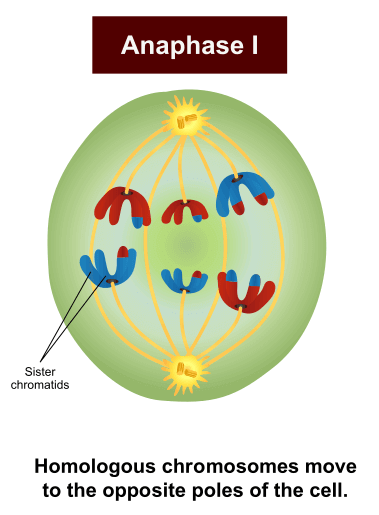
3) Anaphase-1: Homologous pairs separate and are pulled to opposite poles of the cell.
4) Telophase-1: The cell divides into two daughter cells, each with one set of chromosomes.
Prophase-1: Prophase I can be further divided into five sub-stages:
- leptotene
- zygotene
- pachytene
- diplotene
- diakinesis
1) Leptotene: the chromosomes begin to condense, and the nuclear envelope starts to break down.
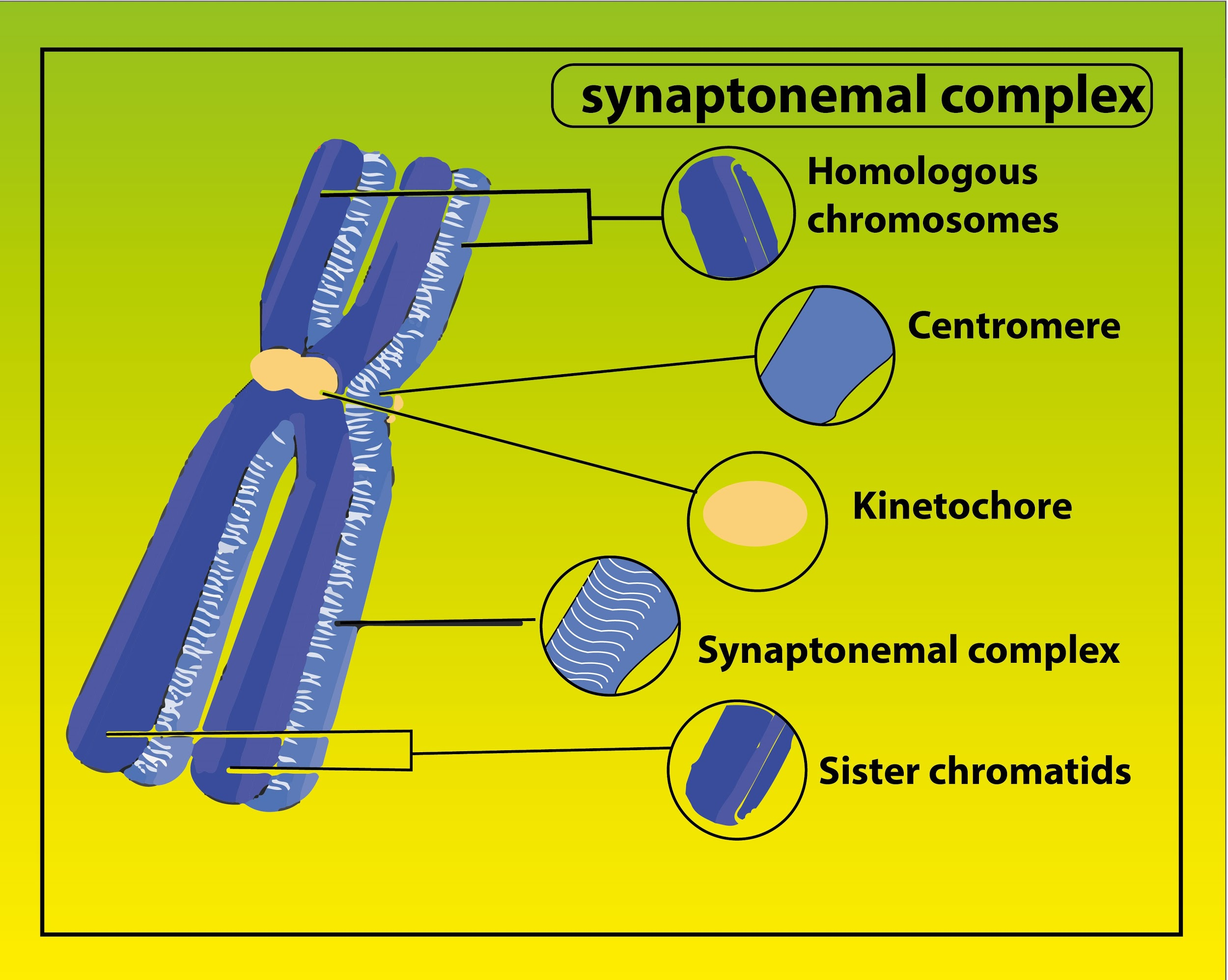
2) Zygotene: the homologous chromosomes begin to pair up and undergo synapsis, forming bivalents.
3) Pachytene: the bivalents continue to condense and crossing over occurs.
4) Diplotene: the bivalents start to separate, but remain connected at points called chiasmata. In oocytes of some vertebrates, diplotene can last for months or years.
5) Diakinesis: This is marked by terminalization of chiasmata. By the end of diakinesis, the
nucleolus disappears and the nuclear envelope also breaks down. Diakinesis represents transition to metaphase.
Overall, prophase I is a crucial stage in meiosis I that allows for genetic variation through crossing over, pairing of homologous chromosomes, and bivalent formation.


1) https://d3jlfsfsyc6yvi.cloudfront.net/image/mw:1024/q:85/https%3A%2F%2Fhaygot.s3.amazonaws.com%3A443%2Fcheatsheet%2F11135.PNG



2) https://haygot.s3.amazonaws.com/questions/1738714_1823816_ans_121b958c2a1e4abebc09a74e4b5513bf.png
3) https://haygot.s3.amazonaws.com/questions/1048699_1123913_ans_44e2383519014e1f8cb16d832bd3df85.png
Synaptonemal complex:
Source: https://www.vedantu.com/question-sets/1cf84dc9-5b4d-44f7-943a-f591aa2eb41c4887100078879057028.png
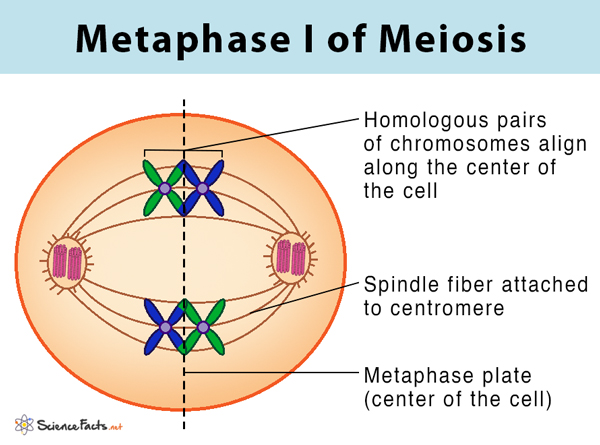
Metaphase-1: The bivalent chromosomes align on the equatorial plate. The microtubules from the opposite poles of the spindle
attach to the kinetochore of homologous chromosomes.
Anaphase-1: The homologous chromosomes separate, while sister
chromatids remain associated at their centromeres.
SOURCE:
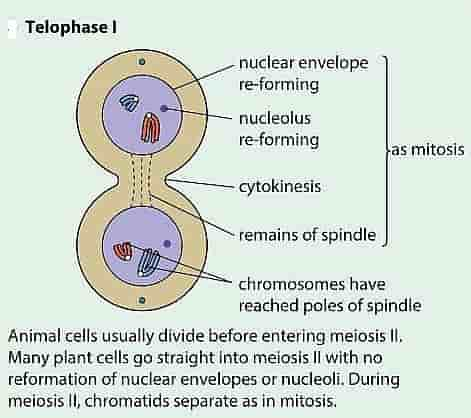
Telophase 1: The nuclear membrane and nucleolus reappear; cytokinesis
follows and this is called as dyad of cells. The stage between
the two meiotic divisions is called interkinesis and is generally short lived.
There is no replication of DNA during interkinesis. Interkinesis is followed
by prophase II, a much simpler prophase than prophase I.
Source:
Meiosis II: This phase resembles a normal mitosis.
Stages:
- Prophase II: Chromosomes condense again and spindle fibers begin to form.
- Metaphase II: Chromosomes align at the cell equator. the microtubules from opposite poles of the spindle get attached to thekinetochores of sister chromatids.
- Anaphase II: Sister chromatids separate and are pulled to opposite poles of the cell by shortening of microtubules attached to kinetochore.
- Telophase II: the two groups of chromosomes once again get enclosed by a nuclearenvelope, the cytokinesis follows resulting in the formation of four haploid daughter cells.
Significance of Meiosis:
1) Genetic diversity
2) Maintenance of chromosome number
3) Genetic recombination
4) Prevention of genetic abnormalities
* Variations are very important for the process of evolution.
Previous year NEET questions:
1) The appearance of recombination nodule on homologous chromosomes during meiosis characterizes
NEET 2022
a) bivalent
b) sites at which crossing over occurs
c) terminalization
d) synaptonemal complex
Answer: b
2) Regarding meiosis, which of the statements is incorrect?
NEET 2022
a) DNA replication occurs in S-phase of meiosis-II
b) Pairing of homologous chromosomes and recombination occurs in meiosis-I
c) Four haploid cells are formed at the end of meiosis-II
d) There are two stages in meiosis, meiosis-I and II
Answer: a
3) which stage of meiotic prophase shows terminilization of chiasmata as its distinctive feature?
NEET 2021
a) Leptotene
b) Zygotene
c) Diakinesis
d) Pachytene
Answer: c
4) Which of the following stages of meiosis involves division of centromere?
NEET 2021
a) Metaphase-I
b) Metaphase-II
c) Anaphase-II
d) Telophase-II
Answer: c
5) During meiosis I, in which stage synapsis takes place?
a) Pachytene
b) Zygotene
c) Diplotene
d) Leptotene
Answer: b
6) Dissolution of the synaptonemal complex occurs during
a) zygotene
b) diplotene
c) leptotene
d) pachytene
Answer: b
7) After meiosis-I, the resultant daughter cells have
a) same amount of DNA as in the parent cell in S-phase
b) twice the amount of DNA in comparision to haploid gamete
c) same amount of DNA in comparision to haploid gamete
d) four times the amount of DNA in comparision to haploid gamete
Answer: b
8) Meiosis takes place in
NEET 2013
a) Meiocyte
b) conidia
c) gemmule
d) megaspore
Ansewer: a

No comments:
Post a Comment